
Stainless Steel Coil
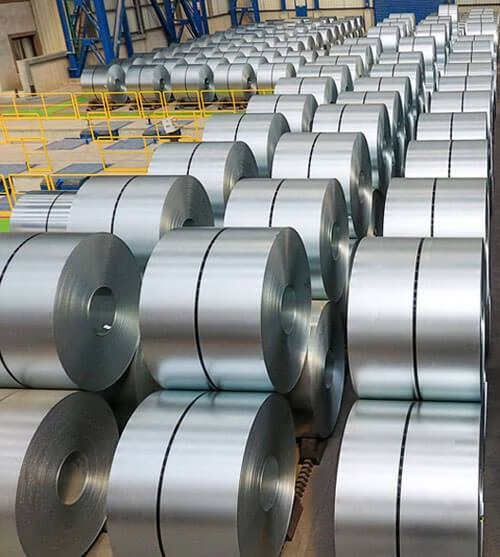
Stainless steel coil is a flat-rolled product made from iron-chromium alloys with a minimum of 10.5% chromium, offering excellent corrosion resistance, formability, and hygiene for diverse industrial applications.
Material
Stainless Steel. Representative grades include Austenitic 304/304L, 316/316L, 321; Ferritic 430, 439, 441; Duplex 2205, 2507; Martensitic 410, 420.
Model
SS Coil, 2B Coil, BA Coil, No.4 Coil
Size
Standard widths range from 600 mm to 2000 mm, with precision slitting available for narrower strip requirements.
Thickness
0.3 mm to 12.0 mm for cold rolled coils; 2.0 mm to 25.0 mm for hot rolled coils.
Standard
ASTM A240/A240M, ASTM A666; EN 10088-2; JIS G4305, G4307; GB/T 3280, GB/T 4237.
MOQ
5 Metric Tons.
Delivery Time
Standard lead time is 3 to 8 weeks from order confirmation, dependent on grade, finish, and quantity.
Long Description
Stainless steel coil is manufactured by hot rolling or cold rolling stainless steel slabs, utilizing alloys that primarily consist of iron, chromium, nickel, and other elements like molybdenum or nitrogen. The chromium content forms a passive, self-repairing oxide layer that provides inherent corrosion resistance. This product category encompasses several metallurgical families: Austenitic (300 series, non-magnetic, excellent formability and toughness), Ferritic (400 series, magnetic, moderate corrosion resistance), Martensitic (magnetic, heat-treatable for hardness), and Duplex (mixed austenitic-ferritic structure, high strength and corrosion resistance). Coils are produced in a range of thicknesses, widths, and surface finishes, from matte to mirror-like. They serve as the primary feedstock for further processing into sheets, strips, tubes, and fabricated components across industries where durability, cleanliness, and aesthetic appeal are critical.
Key Product Highlights
Stainless steel coil provides superior corrosion resistance compared to carbon steel, suitable for harsh and hygienic environments.
Available in multiple alloy families (Austenitic, Ferritic, Duplex, Martensitic) to match specific mechanical and corrosion requirements.
A wide variety of standardized mill finishes are offered, from annealed and pickled to bright annealed and polished.
The material exhibits excellent formability and weldability, particularly in austenitic grades like 304 and 316.
Maintains good mechanical properties across a wide temperature range, from cryogenic to elevated temperatures.
Product Advantages
Controlled alloy composition ensures consistent performance, including corrosion resistance, strength, and magnetic properties.
Standardized production to global specifications (ASTM, EN, JIS) guarantees material traceability and quality assurance.
Coil dimensions and surface finishes can be customized to optimize yield and efficiency in downstream manufacturing processes.
The material’s longevity and low maintenance requirements contribute to a lower total cost of ownership in demanding applications.
Supply is supported by comprehensive mill test certification for chemical composition, mechanical properties, and surface quality.
Industry Application
This coil is used for manufacturing chemical processing equipment, food service appliances and tanks, architectural cladding and roofing, automotive exhaust systems, heat exchangers, pharmaceutical tubing, kitchen sinks, and decorative trim.
Technical Specifications
| Parameter | Unit | Austenitic (e.g., 304) | Ferritic (e.g., 430) | Duplex (e.g., 2205) | Notes |
|---|---|---|---|---|---|
| Carbon Content (C) | % | ≤ 0.08 (304) / ≤0.03 (304L) | ≤ 0.12 | ≤ 0.030 | Low carbon (L) grades improve weldability. |
| Chromium (Cr) | % | 18.0 – 20.0 | 16.0 – 18.0 | 21.0 – 23.0 | Primary element for corrosion resistance. |
| Nickel (Ni) | % | 8.0 – 10.5 | ≤ 0.75 | 4.5 – 6.5 | Austenite former; key for 300 series and duplex. |
| Molybdenum (Mo) | % | – (304) / 2.0-3.0 (316) | – | 2.5 – 3.5 | Enhances pitting and crevice corrosion resistance. |
| Tensile Strength | MPa | ≥ 515 | ≥ 450 | ≥ 620 | Minimum values per common standards. |
| Yield Strength | MPa | ≥ 205 | ≥ 205 | ≥ 450 | Duplex grades have significantly higher yield strength. |
| Elongation | % | ≥ 40 | ≥ 22 | ≥ 25 | Minimum values. |
| Hardness | HB | ≤ 201 | ≤ 183 | ≤ 293 | Maximum typical Brinell hardness. |
| Thickness (CR) | mm | 0.3 – 6.0 | 0.3 – 6.0 | 0.5 – 6.0 | Typical Cold Rolled range. |
| Width | mm | 600 – 2000 | 600 – 1600 | 600 – 2000 | |
| Coil Weight | MT | 3 – 20 | 3 – 15 | 3 – 15 | Typical export coil weight. |
| Surface Treatment | – | Annealed & Pickled, Bright Annealed (BA) | Annealed & Pickled | Annealed & Pickled | Standard as-supplied condition. |
| Coating / Finish | – | 2B, BA, No.4, HL, Mirror | 2D, 2B | 2B, No.1 | Industry-standard finish designations. |
| Rolling Type | – | Hot or Cold Rolling | Hot or Cold Rolling | Hot or Cold Rolling | Defines the initial manufacturing process. |
| Standard Example | – | ASTM A240 304 2B | ASTM A240 430 | ASTM A240 S32205 | Representative standard, grade, and finish. |
Packaging & Surface Treatment
Coils are packaged for export with extreme care to prevent surface scratches, contamination, and moisture ingress. They are wound on cardboard or steel sleeves, interleaved with protective paper or plastic, wrapped in multiple layers of waterproof VCI paper and heavy-gauge plastic, and secured on steel skids with protective edge guards. Standard surface finishes include 2B (cold rolled, annealed, pickled, with a smooth matte finish), BA (Bright Annealed, highly reflective), and polished finishes like No.4 (brushed) or HL (hairline).
Aliases Names
Stainless Coil, SS Coil, CR Stainless Coil, HR Stainless Coil, Corrosion Resistant Steel Coil, 304 Coil, 316 Coil.
